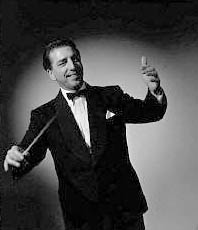
Born Annunzio Paolo Mantovani, 15 November 1905, Venice, Italy, died 30 March 1980, Tunbridge Wells, Kent, England. A violinist, pianist, musical director, conductor, composer and arranger, Mantovani was one of the most successful orchestra leaders and album sellers in the history of popular music. His father was principal violinist at La Scala, Milan, under Arturo Toscanini, and also served under Mascagni, Richter and Saint-Saens, and subsequently, led the Covent Garden Orchestra. It is said that Mantovani received encouragement to become a professional musician from his mother, rather than his father. He began his musical training on the piano, and later learned to play the violin. After the family moved to England in 1912, he made his professional debut at the age of 16, playing the Bruch Violin Concerto Number 1. Four years later he had installed his own orchestra at London's Hotel Metropole, and began his broadcasting career. In the early 30s he formed the Tipica Orchestra and began a series of lunchtime broadcasts from the famous Monseigneur Restaurant in Piccadilly, London, and started recording for Regal Zonophone. He had two US hits in 1935-36, with 'Red Sails In The Sunset' and 'Serenade In The Night'. In the 40s, Mantovani served as musical director for several London West End shows, including Lady Behave, Twenty To One, Meet Me Victoria, And So To Bed, Bob's Your Uncle and La-Di-Da-Di-Da. He was also involved in Noel Coward's Pacific 1860 and Ace Of Clubs; conducting from the theatre pit for artists such as Lupino Lane, Pat Kirkwood, Mary Martin, Sally Gray, Leslie Henson and many others. His records for UK Decca included 'The Green Cockatoo', 'Hear My Song, Violetta' and 'Tell Me, Marianne' (vocal by Val Merrall). Experimenting with various arrangements with which to target the lucrative US market, he, came up with what has been variously called the 'cascading strings', 'cascading violins', or 'tumbling strings' effect, said to be an original idea of arranger Ronald Binge. It became, the Orchestra's trademark and was first used to great effect in 1951, on Mantovani's recording of 'Charmaine', a song originally written to promote the 1926 silent film classic What Price Glory?. The Mantovani recording was the first of several million-selling singles for his orchestra, which included 'Wyoming', (another 20s number), 'Greensleeves', 'Song From Moulin Rouge' (a UK number 1), 'Swedish Rhapsody' and 'Lonely Ballerina'. Mantovani's own compositions included 'Serenata d'Amore', 'A Poem To The Moon', 'Royal Blue Waltz', 'Dance Of The Eighth Veil', 'Toy Shop Ballet' (Ivor Novello Award 1956), 'Red Petticoats', 'Brass Buttons'. 'Tango In the Night' and 'Cara Mia', written with UK record producer/manager Bunny Lewis. David Whitfield's 1954 recording of 'Cara Mia', with Mantovani's orchestra accompaniment, sold over a million copies, and stayed at number 1 in the UK charts for a record (at the time) 10 weeks. It also made Whitfield one of the earliest UK artists to break into the US Top 10. Mantovani issued an instrumental version of the number, featuring himself on piano. This was most unusual in that the instrument was rarely a part of his 40-piece orchestral set-up. Singles apart, it was as an album artist that Mantovani excelled around the world, and especially in the USA. He is said to have been the first to sell over a million stereo units, aided in no small measure by the superb quality of sound obtained by Decca. Between 1955 and 1966 he had 28 albums in the US Top 30. Although he toured many countries of the world, including Russia, his popularity in the LISA, where his style of orchestral offerings were often referred to as 'the beautiful music', was unique. An indication of the US audience's devotion can be gained from a claim by George Elrick, Mantovani's manager of 21 years, that at the beginning of one tour of the USA, the maestro was taken ill and a few concerts had to be cancelled: the prospective capacity audience at one of them, the University of Minnesota and Minneapolis, refused to claim refunds, preferring to retain their tickets for the following year. Mantovani continued to perform throughout the 60s and 70s. He was awarded a special Ivor Novello Award in 1956 for services to popular music.

When Mantovani recorded Charmaine in 1951, he had already given up playing violin to concentrate on conducting, arranging and composing. During the 1940s, however, he was the featured pianist on some of his own Decca recordings under the name of Ivan Fosello. His early musical training was on piano so this should not seem too much of a surprise. When composing he also invariably used piano rather than violin.
What has been a surprise, however, is to discover that he played the piano solo on a number of the large string orchestra recordings. So far six examples have been identified where Mantovani was almost certainly the pianist. Two of these are beyond question: on the British album sleeve notes of the 1960 album "Songs To Remember" Mantovani is clearly shown as the solo pianist on "When I Fall in Love"; and George Elrick, Mantovani's manager/agent, confirmed on a radio program that it was indeed Monty who played piano on the instrumental version of "Cara Mia" from the 1966 album "Mantovani Magic"
Armed with this information you can go hunting for other examples. In June 1958 Mantovani recorded his own composition "Only Yesterday" for a Decca and London 45 rpm single and the aural trademarks of the maestro's piano style are in evidence; incidentally, this was the only occasion where he used the pseudonym Roy Faye as composer.
In November of the same year the two versions of the film theme "Separate Tables" were taped with Mantovani apparently on piano again; one of these was solely orchestral for the "Film Encores Volume 2" album, the other was accompanying the plummy voiced English actor Anthony Oliver who intoned words presumably from the film with the Orchestra in the background. This particular recording is a real oddity and was released only as a single on Decca and London.
Finally, on the British album "Mantovani Concert Spectacular" (1960) the pianist on "Forgotten Dreams" is almost certainly Mantovani again. In the words of US musicologist Donald Southwell, "the light expressive keyboard touch, the rubatos, and the seamless way in which he enters and ends with the Orchestra" are all in evidence.
No doubt there are other examples waiting for us to discover from what is another fascinating aspect of an extraordinary musical career."
More info to follow (Mantovani also used the name Gandino on some early 78's)
Martins Mantovani records.xls (Excel Format)
Martins Mantovani records.pdf (Adobe Acrobat Format) Quickest download
Play a segment of Mantovani's version of the Blue Danube Waltz